Group exercise 5.9 · Network attention meets text
Famous in the graph.
Long on the page?
Characters linked by more of the Marvel articles tend to get longer articles themselves. But Brian Braddock gets 7,294 word-like tokens and just one incoming link. The exceptions reveal what a count of links leaves out.
Explore the graphs ↓ Explore nodes & connections ↓303Articles matched to the full roster
727,203Word-like tokens counted
0.751Rank correlation: incoming links vs length
17Isolated characters retained
01 · The question
Does attention
buy more words?
Our network measures how the 303 Marvel Wikipedia articles link to one another. Now each node also has a document: its frozen article text. We ask whether characters referenced by more of the other articles receive more space on their own page.
We measure attention as the number of distinct source articles linking to a character (in-degree). One page linking to Spider-Man contributes one incoming link, however often it mentions him. This is attention within the shared roster; it does not measure readers, sales, or popularity across all of Wikipedia.
Length is the number of word-like occurrences (tokens) in the frozen text. Ten appearances of the same word count ten times. We are measuring how much text there is, so common words stay in the count.
Follow the links.
Find the character.
Each node is one of our 303 frozen character articles. An arrow from A to B means A's article links to B's article—not that the characters are friends. Explore who links to a long article and which pages it points to.
Loading the frozen network… The analysis below remains available if this view cannot load.
Selected Links into selected Links out of selected Links both ways
Click a node or choose a character above. Drag a node to rearrange it; drag empty space to pan. Use + / − or Ctrl/⌘ + wheel to zoom. On a focused node, ← / → selects another visible character. Direct connections only removes every link not touching the selected article. The full view retains all 1,784 links; its direction control changes the highlighted links, not the underlying network.
Articles linking in
Articles linked out
Positions are only a reading aid: springs pull linked nodes together, without using link direction. They are not a measured similarity, community label or popularity score. The 17 isolated articles sit in a separate tray in the full view. Article selections are shared with the scatter plot below; its length filters do not filter this network.
02 · Make the units explicit
Count what
you mean.
We join the official text archive to the original node roster by article ID, decoding the archive's filenames first. All 303 IDs match. We keep the full directed network: 58 articles have no incoming link, and 17 have no link in either direction.
The tokenizer keeps runs of Unicode word-like characters and internal apostrophes. Hyphens split a name; decimal digits and punctuation do not count. Capitalization and ordinary word forms are retained. We do not remove common words or map word forms to their dictionary form. Letter-like number symbols, such as Ⅳ, can still count as word-like units under these rules.
For example, Spider-Man didn't save Queens; Doctor Strange's portal did! becomes these nine tokens:
SpiderMandidn'tsaveQueensDoctorStrange'sportaldid
These are word-like units chosen for counting article length. A language model's subword tokenizer would make different units and give different totals.
Try the boundaries yourself
Unchecked options match our article-length rules. Changing them here does not change the saved article measurements. Try Hero hero HERO: lowercasing changes the number of distinct words (types), not the number of occurrences (tokens). Splitting at apostrophes is a boundary rule, not a linguistic analysis.
How we compare pages and pick the exceptions
Our main summary is rank correlation (Spearman's ρ): do pages near the top for incoming links also rank near the top for length? Tied values receive average ranks. A value of +1 means identical rank order; 0 means no rank correlation; −1 means reversed rank order.
For a readable trend and a consistent way to find exceptions, we fit a straight line to log(length) against log(1 + incoming links), using all 303 pages. Adding one keeps zero-link articles in the calculation. The fitted equation is:
ln(tokens) = 6.3155 + 0.7233 × ln(1 + incoming links)
After converting the fitted value back to a token count, we compare observed length with that guide. The residual is the vertical gap on the log plot; equivalently, we can report the observed/fitted ratio. We inspect the three greatest positive gaps and the greatest negative gap. This rule selects examples after seeing the data; they are not a representative sample.
The curve is a descriptive fit to this corpus. Its converted predictions describe a log-scale trend, rather than the arithmetic mean length of all pages with that degree. We use no significance threshold and make no causal claim.
03 · The relationship
More links usually
means more text.
Your turn · 303 pages, no new data
Move from the pattern
to the page.
Click a point to inspect its article. Change the units or the roster, then select a bar to isolate a band of article lengths.
- Articles shown
- 303
- Rank correlation · shown articles
- 0.751
- Median length · shown articles
- 1,238
Article Text-checked exception Selected article Full-roster trend
Further right means more incoming links; higher means longer text. Logarithmic spacing makes equal ratios equally far apart. The curve always uses all 303 pages and the chosen length measure; filters do not refit it. Use the character selector, or focus a point and use ← / → to step through visible articles.
How is length distributed?
Bar height counts articles, not words. Click a bar to narrow the scatter plot.
Explore subsets, but compare them carefully: restricting the range can change the correlation. A rank correlation is undefined when every article has the same incoming-link count, as with the isolated articles. None of these views tests cause and effect.
Original figure · open or download
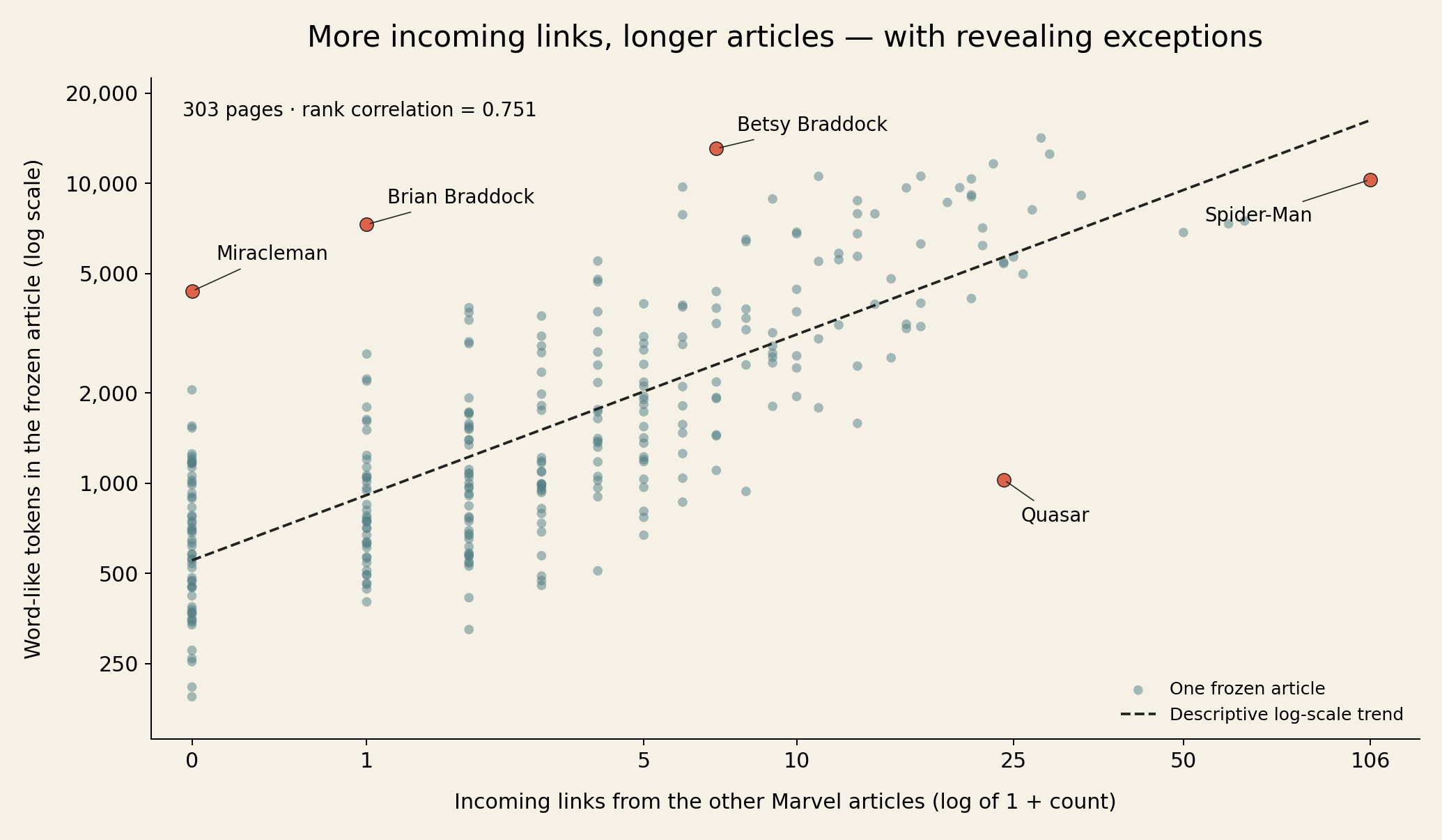
The rank correlation is 0.751. There is a strong positive association in this snapshot: articles with more incoming links generally contain more words. The fitted line has R² = 0.590 in log space, so substantial variation remains around it.
The relationship is similar when length is measured by characters (ρ = 0.753) or simple whitespace-separated chunks (ρ = 0.751). It also remains positive among the 245 pages with at least one incoming link (ρ = 0.729). These checks suggest that the broad result does not depend on our particular token boundary rules or only on the zero-link pages.
The exceptions are large. Brian Braddock is about 7.99 times the fitted length for his in-degree, while Quasar is 0.18 times the fit. Reading the articles is the next step in understanding those gaps.
| Article | Incoming links | Word-like tokens | Fitted guide | Observed / fitted |
|---|---|---|---|---|
| Brian Braddock | 1 | 7,294 | 913 | 7.99× |
| Miracleman | 0 | 4,367 | 553 | 7.90× |
| Betsy Braddock | 7 | 13,061 | 2,489 | 5.25× |
| Quasar | 24 | 1,028 | 5,674 | 0.18× |
04 · Return to the text
The exceptions
have different stories.
We checked the frozen opening passages and the sections listed below. The quoted fragments are exact matches in the archive. The observations explain what contributes to article length; they do not prove what caused each incoming-link count.
Brian Braddock · 1 incoming link
A long history
behind one link.
“He is the first character in publication to use the Captain Britain moniker”
The lead identifies Brian as the original Captain Britain and later Captain Avalon. Publication history, a long fictional biography and alternate versions give the page a broad scope. His 7,294 tokens sit beside just one incoming link, although he has eleven outgoing links.
Checked: lead, Publication history, Fictional character biography, Other versions. Source article ↗
Miracleman · 0 incoming links
Outside the links,
inside a long article.
“a legal dispute over the character's ownership”
The article traces British origins, several publishers, cancellation, a rights dispute and a later Marvel revival. Much of this history concerns people and publishers outside our character roster. It supports 4,367 tokens even though Miracleman is completely isolated in this frozen network.
Checked: lead, Concept and creation, Publication history, Reception. Source article ↗
Betsy Braddock · 7 incoming links
One article,
several identities.
“Following nearly 30 years of publication history”
The lead discusses Betsy's Psylocke identity, the body swap involving Kwannon and the later Captain Britain mantle. Publication history, fictional biography and media adaptations give the page a broad scope. We also found an empty Collections heading in the extraction; a heading alone is not evidence of substantive text.
Checked: lead and passages from Publication history, Fictional character biography, Lady Mandarin and body swap, In other media. Source article ↗
Quasar · 24 incoming links
One short page,
several people.
“Quasar is the name of several superheroes”
The 1,028-token page is a compact overview of a shared name. Its biography sections cover Wendell Vaughn, Phyla-Vell, Richard Rider and Avril Kincaid, followed by the Quantum Bands' powers. Twenty-four other articles link to this umbrella page. A node can summarize several fictional people.
Checked: lead, all four biography subsections, Powers and abilities. Source article ↗
Quotations: Wikipedia contributors, via the course's 26 August 2026 text snapshot. The linked live articles may have changed. The exact input archive and the inspection notes are available below.
05 · What we learned
Length records
more than attention.
The surprise is that a strong overall association can coexist with a character whose page is nearly eight times the fitted length despite just one incoming link. The text checks suggest that publication history, changing identities and article scope contribute to those exceptions.
Our main limitation: this is one frozen corpus of 303 articles. Its boundaries exclude other Wikipedia pages, creators, publishers and many fictional characters. Incoming links therefore capture a limited kind of attention. Article length also depends on editorial choices, and a shared superhero name may have a different article structure from an individual character.
We count the supplied text as it stands, including section headings and remaining reference or external-link text. We checked selected passages, rather than coding every paragraph by topic. The correlations describe this corpus; they do not show that gaining a link causes an article to grow, and the fitted curve is not a universal law.
Next question: does the association change when publication history, fictional biography and other sections are counted separately? The inspected exceptions give a concrete reason to try that, with heading detection checked by hand.
06 · Open the workings
Read it.
Rerun it.
The notebook reruns the analysis and contains saved outputs. The script reads the frozen text in place, checks the exact join to the roster and retains all isolated nodes. The verification also checks our short quotations against the source text.
- Executed notebook on GitHub · download notebook
- Analysis script · pinned dependencies
- All 303 page measurements (CSV) · results, hashes and versions (JSON)
- Directed network and display coordinates (JSON) · reproducible layout script
- Text inspection notes · unchanged official text archive · data provenance and attribution
- Original roster · original directed edges
Requirements: 2026 Week 5 exercise 5.9, using its article-length question. Method context: turning text into tokens.
AI assistance: Codex helped choose the question, write and execute the analysis, inspect the frozen passages and draft this post. The recorded passages and results make the interpretation checkable.