Group exercise 3.12 · Brokers, compared to what
The bridges
degree misses.
Who is surprisingly important in the Marvel network? We keep every character's degree fixed, shuffle the links 200 times, and look for betweenness that cannot be explained by popularity alone.
01 · The question
Popularity is not
control.
Degree asks how many direct connections a character has. Betweenness asks a different question: how often does a character sit on the shortest route between other pairs?
A high-degree character can be popular without being a broker. A low-degree character can control access between parts of the network if removing it forces many routes to go elsewhere.
b(i) = sum over pairs s,t of shortest paths through i / all shortest paths from s to t
Following the Week 3 prompt, we ask: which characters have more betweenness than their degree should produce?
02 · The comparison
Keep degrees.
Move the bridges.
We use the original undirected giant component: 277 characters and 1,421 links. For every null network, we perform successful double-edge swaps. The swaps change who connects to whom, while every character keeps exactly the same degree.
We compute betweenness in the real network and in 200 shuffled networks. For each character, the surprise score is the distance between the real value and the shuffle mean, measured in shuffle standard deviations:
z = (real betweenness - null mean) / null standard deviation
This is a degree-preserving comparison, not a claim that the shuffle is a perfect model of Wikipedia. It answers the narrower question: is this position more broker-like than its degree sequence alone tends to create?
02A · Explore the answer
Find the
bridge.
Choose a character to see its local neighborhood and how unusual its betweenness is against the degree-preserving null. Then choose two characters to trace a shortest chain between them.
Loading the graph data...
Select two characters to find their shortest path.
03 · Remove the brokers
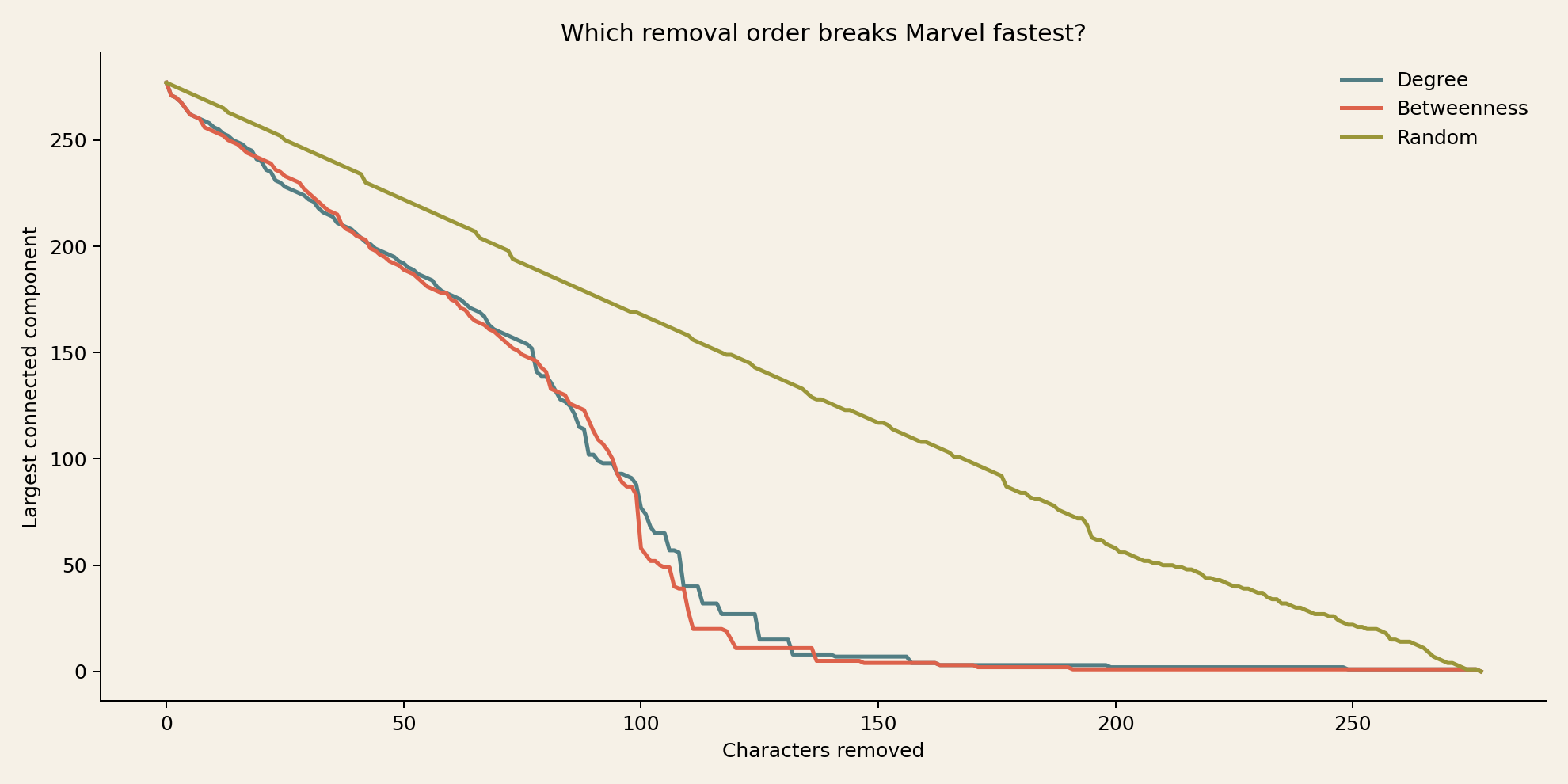
Spider-Man holds
the giant together.
We removed every character once from the 277-node giant component and measured the size of the largest connected component that remained. Removing Spider-Man leaves 271 nodes in the giant component: the largest single drop, losing six nodes from the original giant.
Spider-Man is also the highest-betweenness character in the real network. Here, the two answers agree: the character whose shortest-path position is most central is also the one whose removal fragments the network most in this single-node test.
04 · Direction matters
Some pages
speak into silence.
When we keep the arrows, in-degree measures how often a character is mentioned and out-degree measures how many other characters that page mentions. The rankings can disagree sharply.
Shamrock is the clearest out-linking outlier: 8 out-links but 0 in-links, ranking 88th by out-degree and 290th by in-degree. Isaiah Bradley has the same pattern at 7 out-links and 0 in-links. These are pages that point into the shared universe without being pointed back to in this snapshot.
| Character | In | Out | In rank | Out rank |
|---|---|---|---|---|
| Shamrock ↗ | 0 | 8 | 290 | 88 |
| Solo ↗ | 1 | 12 | 239 | 42 |
| Isaiah Bradley ↗ | 0 | 7 | 275 | 99 |
| Spider-Bitch ↗ | 2 | 15 | 194 | 21 |
| Brian Braddock ↗ | 1 | 11 | 211 | 46 |
The linked pages give the editorial context for these asymmetries. The graph claim remains narrower: in this snapshot, these pages link outward much more than other pages link inward to them.
05 · Six degrees
Everyone comes
back to Spidey.
Choose any character in the giant component and we return one shortest chain to Spider-Man. The longest distance in this snapshot is 3 links, shared by 18 characters. One example is Box → Guardian → Puck → Spider-Man.
Type a character to see its shortest chain.
Longest chain found: 3 links. Ties are retained in the saved analysis.
06 · Cliques and homophily
A dense core,
then a cautious claim.
The largest cliques have size 8. The top examples are overwhelmingly X-Men characters: Betsy Braddock, Cable, Cyclops, Emma Frost, Jean Grey, Rachel Summers and Wolverine, with the eighth position varying between Jubilee, Northstar, Phoenix Force and Storm. The largest cliques are therefore team-like, but clique membership alone does not prove a team caused the links.
For an exploratory homophily test, we assign a faction only when the frozen Wikipedia description explicitly names one of the selected groups. Among the 8 labelled characters, the real attribute assortativity is 0.741, versus a label-permutation null mean of -0.172 (z = 3.94). The observed labels are more same-faction than chance in this restricted subset.
This is deliberately a weakly powered, text-derived attribute test: most descriptions do not name a faction, so it is evidence for a follow-up, not a general estimate of Marvel homophily. A proper extension would scrape consistent team membership for all characters and repeat the label permutation, ideally stratified by degree.
- Betsy Braddock · Cable · Cyclops · Emma Frost · Jean Grey · Jubilee · Rachel Summers · Wolverine
- Betsy Braddock · Cable · Cyclops · Emma Frost · Jean Grey · Northstar · Rachel Summers · Wolverine
- Anya Corazon · Mayday Parker · Spider-Girl · Spider-Man · Spider-Woman · Spider-Woman (Gwen Stacy)
07 · The result
Rockman is the
smallest big deal.
| Character | Degree | Real betweenness | Null mean | z-score |
|---|---|---|---|---|
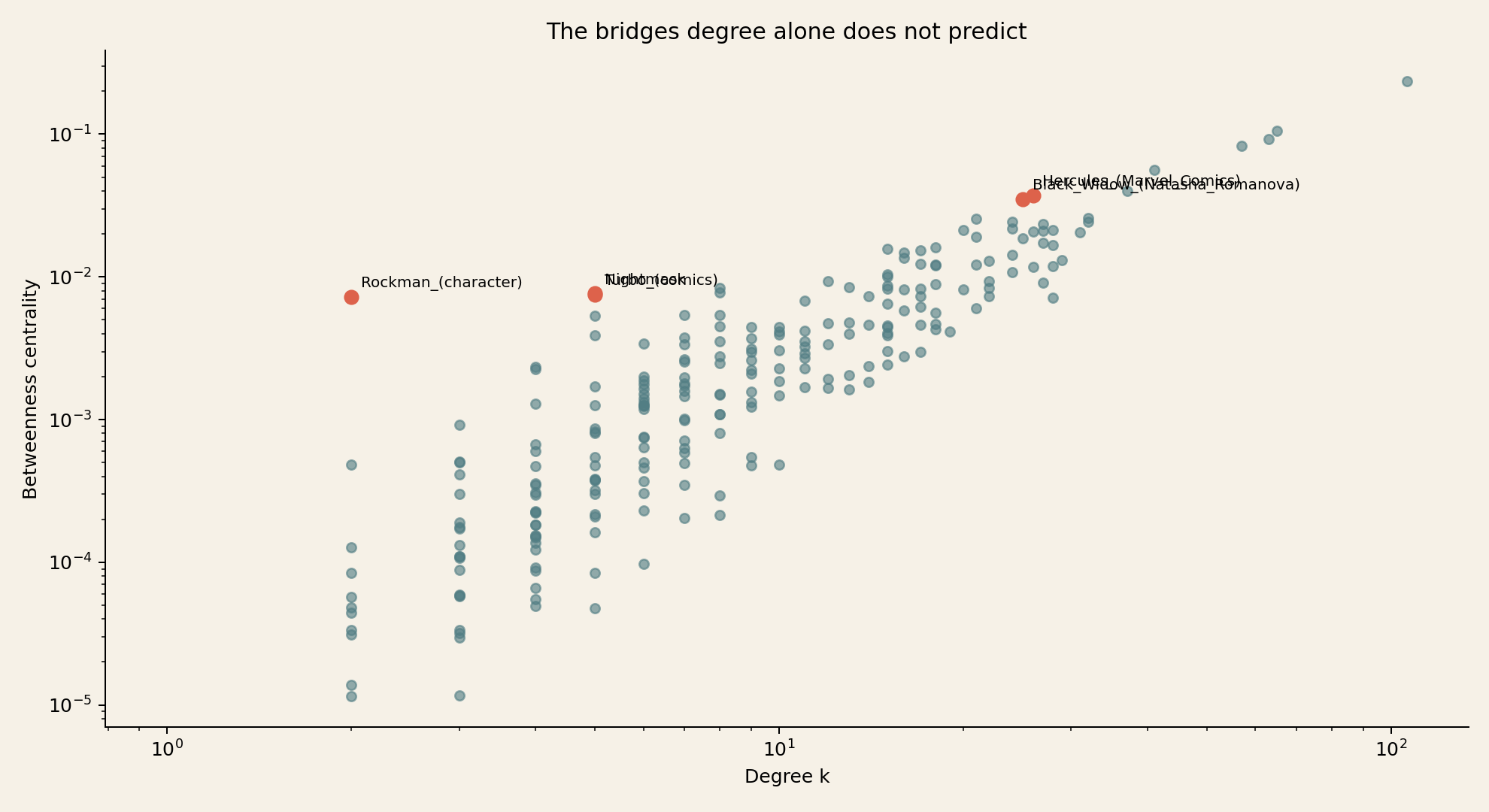
| Rockman | 2 | 0.00725 | 0.00023 | +6.88 |
| Turbo | 5 | 0.00751 | 0.00094 | +4.63 |
| Nightmask | 5 | 0.00766 | 0.00090 | +4.44 |
| Hercules | 26 | 0.03738 | 0.01756 | +4.42 |
| Black Widow | 25 | 0.03512 | 0.01602 | +4.39 |
| Black Cat | 28 | 0.00715 | 0.02008 | -2.62 |
The surprise is not Spider-Man. Spider-Man's raw centrality is high, but a hub with a very large degree is expected to lie on many shortest paths. Rockman is different: with only two links, his betweenness is 6.88 shuffle standard deviations above the degree-preserving expectation.
The negative side matters too. Black Cat has 28 links, but her betweenness is below the shuffled expectation. Many of her connections have alternative routes around them, so popularity does not make her a structural bottleneck.
08 · The two-link broker
One door
between worlds.
Rockman's two neighbors are Black Widow and The Witness. That tiny neighborhood is exactly why the result is interesting: Rockman is not influential because he has a large audience. He is influential because his two links connect positions that are otherwise rarely connected in the null networks.
In the real graph, a shortest path between many nodes on opposite sides can pass through this narrow route. In a degree-preserving shuffle, a two-link character usually lands in a less strategically placed pair of neighborhoods, so its betweenness is close to zero.
What do the larger brokers bridge?
Hercules and Black Widow show the same effect at a larger scale. Hercules links a broad set spanning Avengers, cosmic characters, Asgard and Hulk-related characters. Black Widow's neighborhood crosses Avengers, Spider-Man, X-related and villain-linked areas. Their degrees matter, but their positions matter more than degree predicts.
- Rockman · Black Widow · The Witness
- Hercules · Hulk · Spider-Man · Wolverine · Ares · Black Widow
- Black Widow · Hawkeye · Iron Man · Red Guardian · Spider-Man · Wolverine
- Turbo · Darkhawk · Nova · Phil Urich · Rom
09 · What it means
Surprising
is conditional.
The right conclusion is not “Rockman is the most important character.” Betweenness measures control of shortest-path traffic, and our z-score says Rockman's position is unusual given his degree in this graph. That is a precise claim about one measure and one null model.
The network is an undirected projection of Wikipedia hyperlinks, so it does not represent friendship or influence directly. We analyse one frozen snapshot, one connected component and 200 randomised networks. More shuffles would make the null estimate more stable; a different null model could answer a different question.
Week 3's central lesson is therefore also the method: say which question a centrality answers, and say compared to what.
10 · Open the workings
Rerun it.
Question it.
The results and chart were generated from the frozen Week 1 snapshot. The analysis script checks the component size, performs degree-preserving swaps, saves every character's real and null values, and records the source hashes and software versions.
- Week 3 analysis script
- All 277 character centrality comparisons (CSV) · directed rankings (CSV) · summary and provenance (JSON)
- removal curves (JSON) · removal figure · interactive graph data
- Original node roster · original directed links
- Reference: Week 3 exercise 3.12 and Compared to what?
AI assistance: the LLM helped formulate and implement the analysis and draft the explanation. The degree-preserving validation, saved results and null comparison are published so the claims can be checked.